
The RACER Mailbag, October 21
Welcome to the RACER Mailbag. Questions for any of RACER’s writers can be sent to mailbag@racer.com. We love hearing your comments and opinions, but letters that include a question are more likely to be published. Questions received after 12pm ET each Monday will be saved for the following week.
Q: Just wanted to write in and express my disappointment with the large increase in ticket prices for the Arlington Grand Prix in 2027. They are almost $100 more per seat this year. I went last year with my family, and we enjoyed it a lot. But now it’s too much money for our budget. Just for me and one of my kids would cost almost $600 for the weekend in tickets for grandstand seats. I understand these events cost lots of money to put on, but I just wish they didn't cost an arm and a leg to actually attend. Guess I will be watching this year's race from my couch.
Kevin, Spring, TX
MARSHALL PRUETT: I have a friend who attends a lot of races and they said the renewal for the same grandstand seating they had in 2026 went up a full 25 percent. That’s pretty steep, and they also said that of the 14 races they flew to, Arlington was already the most expensive on the calendar. They’re in a similar situation as you’ve mentioned with having to delete the second running of Arlington due to the big year-to-year spike in ticket price.
It was such a positive event on debut, so I hope the return isn’t subject to smaller crowds due to the apparent cash grab.
Q: Why would any driver or their representatives allow a contact to expire at the end of a calendar year rather than at the end of the season? I know that contact negotiations are a give and take but that seems like it should be standard for a driver to demand.
I also wanted your thoughts about Argentinian fans and how social media truly affects drivers. We have seen two recent examples of drivers negatively impacted by the behavior of their fans.
Obviously, any logical person would think threats to competitors would be out of line, but then why does this seem to keep happening to the detriment of their countryman? Is this a cultural thing? Is it just a few high profile, very loud fans making a problem seem bigger than it truly is? Can you provide some insight?
I’d hate to see this become a problem for future drivers not getting rides because owners don’t want the problems that have already reared their ugly heads in other situations.
Brian, Phoenix, AZ
MP: I don’t track the behavior of Argentinian racing fans, so I can’t answer your questions from firsthand knowledge.
I do know that when IndyCar had the two instances of attacks leveled in Callum Ilott’s direction, his Argentinian team owner Ricardo Juncos and his Argentinian teammate Agustin Canapino, at different times, told me there were big cultural differences where saying mean/threatening things on social media by Argentinians was not viewed as anything serious or alarming. A lot of bluster with no real intent.
They also explained how they struggled to understand why we made such a big deal out of it and largely dismissed the backlash until it finally sunk in that this wasn’t going to go away by ignoring it. As an aside, it’s silly to think that only Argentinian fans are responsible for negative behavior that affects Argentinian drivers. A person from California, or Honduras, or Guam couldn’t contribute to the torrent of attacks?
On contracts, it’s been the norm for a lot of drivers for a long time. Most contracts are of the annual variety. Not sure why this would be different here.
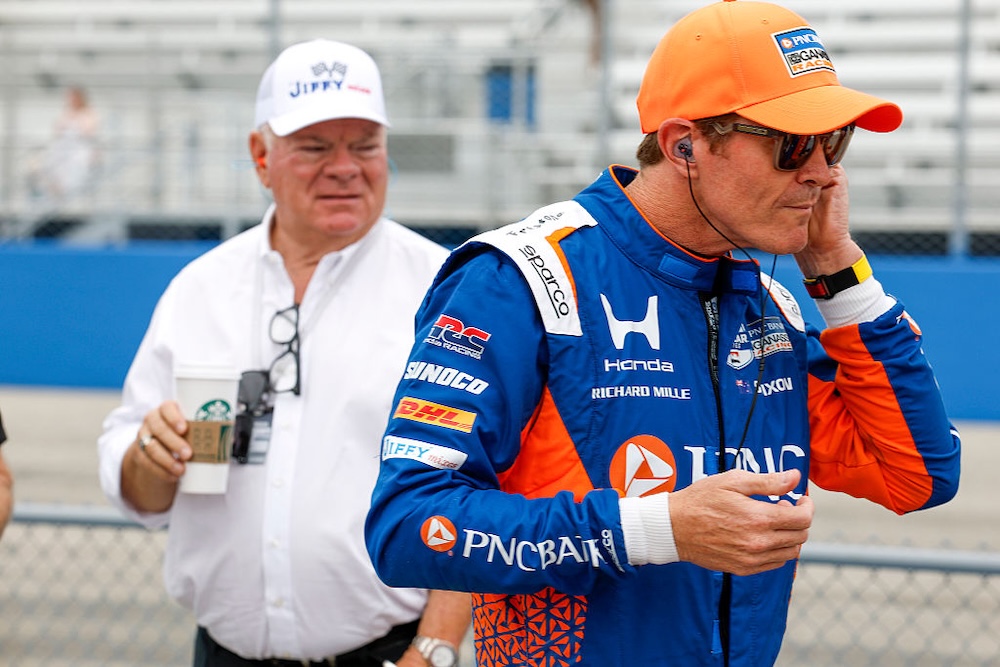
Calendar-year contracts are common, but it usually takes a situation like Dixon's to make one a talking point. As an aside, what do you think Chip's go-to order at Starbucks is? Michael Levitt/Lumen via Getty Images
Q: Wondering if Ford’s decision to not enter IndyCar could have been influenced by Chevrolet extending their engine contracts with McLaren, Penske and ECR, which limited the teams to partner with. And did Chevrolet sense some interest from Ford to enter IndyCar so made a pre-emptive decision? Am I making something out of nothing?
Richard, Pittsburgh, PA
MP: Making something out of nothing. Ford took a quick look and opted against joining. If the Blue Oval did enter the series, it would have teams fighting to be part of its world. With two manufacturers, there’s only two teams for Chevy and two for Honda who are in a constant state of happiness with their engine supplier. The rest are grumpy in some capacity because they don’t get the same results-based love as the top two teams. It’s just the way things work.
So that leaves a lot of really good teams who’d jump in an instant to become a higher priority for a Ford or any other hardcore manufacturer. A Ford would also be expected to try and cherry-pick a championship-caliber team since the ones who’d love to sign are never title contenders.
If and when a serious third manufacturer comes in, and it’s a proven brand, not an aspiring brand without a heavy competition history, you can look for the process outlined here to be the playbook for that manufacturer.
Q: Ford publicly mentioning IndyCar and then quickly U-turning on that mention makes IndyCar’s quest for more engine manufacturers look hopeless.
IndyCar adopted the hybrid to increase its value to manufacturers, but it has only kept Honda around rather than attract new interest. Hypercar prototypes and IndyCar both have hybrids now, but manufacturers would still rather go prototype racing. What exactly makes IndyCar so difficult to convince manufacturers to play over prototypes? I understand the ease of green-lighting GT racing because of its production car relevance, but prototypes don’t have the easiest street recognition either.
What more can IndyCar do on the tech and regs side to make it a better sell? Surely a race that is two-three hours long is an easier sell to American audiences than six hour endurance races with multiple drivers per car.
JJ Wang, Long Beach, CA
MP: A GTP car doesn’t look like a road car, no doubt, but it also doesn’t look too far removed from the wild supercars/hypercars from whatever brand, and there is a long-acknowledged link between the two. BMW has Dallara build its GTP car and has rules that allows it to infuse areas of the bodywork with the exact styles found on its road cars with the kidney-shape grille.
Things like that are a giant point of attraction for manufacturers. A BMW GTP looks nothing like Porsche GTP, and so on, and the differentiation, along with the ability to use dang near any internal combustion engine they want, is why IMSA and WEC are flush with brands.
Manufacturers join F1 for a number of reasons, but at the top of the list, they join because it’s the most popular form of racing in the world, and that’s a great place to promote a brand and sell cars in every corner of the world.
In IndyCar, it’s regional, has no visual differentiation between one manufacturer’s car to the other, and the sole item that makes the car unique to a brand is hidden under a cover in the engine bay.
The one thing that has solved the problem in the recent past – most recently in the 1990s and early 2000s – was popularity. The CART IndyCar Series was extremely popular and many manufacturers joined in while it was riding that peak. And once the wave lost energy, they either left for the Indy Racing League or left altogether.
The hope is for IndyCar and FOX to retore the series’ greater popularity and earn the attention of brands who want to be part of the show. It would be great if it happens, but more time is needed.
Marshall Pruett
The 2026 season marks Marshall Pruett's 40th year working in the sport. In his role today for RACER, Pruett covers open-wheel and sports car racing as a writer, reporter, photographer, and filmmaker. In his previous career, he served as a mechanic, engineer, and team manager in a variety of series, including IndyCar, IMSA, and World Challenge.
Read Marshall Pruett's articles
Latest News
Comments
Comments are disabled until you accept Social Networking Cookies. Update cookie preferences
If the dialog doesn't appear, ad-blockers are often the cause; try disabling yours or see our Social Features Support.